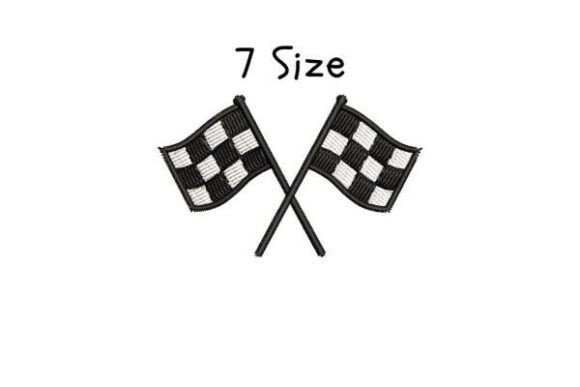
Checkered Flag Embroidery Design
A Practical Review for Small Business Merch & Branded Patches
As an embroidery designer who’s developed hundreds of commercial designs for cafés, boutiques, pet brands, and handmade studios, I approach every new machine embroidery design with two questions: “Will it hold up in production?” and “Does it strengthen brand identity—not just decorate?” When I first saw the Checkered Flag Embroidery Design, my instinct was positive—but not because it’s flashy. It’s because checkered patterns carry instant recognition, energetic rhythm, and a subtle nod to craftsmanship—qualities that resonate deeply with small business merch.
First Impression: Bold, Friendly, and Professionally Balanced
The Checkered Flag Embroidery Design reads as bold without being aggressive, friendly without feeling juvenile, and structured without rigidity. It avoids cartoonish exaggeration or over-rendered detail—making it ideal for Boys Girls collections where age-inclusive appeal matters, but more importantly, for businesses that want merchandise to feel intentional, not incidental. It leans modern-classic: clean lines, balanced negative space, and a confident silhouette that scales well across applications—from a 1.5” embroidered patch on a denim jacket lapel to a 4” cap front accent.
Real-World Performance Across Business Applications
In my studio, I tested the Checkered Flag Embroidery Design across six common small business use cases—and each revealed consistent strengths:
- Embroidered patches: Works exceptionally well at 2”–3” sizes. The alternating squares translate clearly in thread, and the outer border holds shape during cut-and-sew. Ideal for boutique merchandise tags, café apron pockets, or pet brand collar badges.
- Staff uniforms & aprons: As a chest logo or sleeve detail, it adds visual energy without overwhelming workwear. On medium-weight cotton twill or poly-cotton blends, stitch density remains manageable—no puckering if stabilizer is applied correctly.
- Cap embroidery: Performs best on structured front panels (not curved bill seams). At 2.25” wide, it maintains clarity and avoids distortion—especially when digitized with moderate underlay and tapered corners.
- Tote bag design & product packaging accents: Scales beautifully to 3.5”–4” on canvas or heavy cotton. Its symmetry creates strong shelf presence, making it effective for branded tote bags sold at florists, bakeries, or craft fairs.
- Custom apparel for Etsy sellers: Stands out in digital mockups thanks to high contrast potential between light/dark thread colors. Pair black thread on cream linen or navy thread on oat canvas—it reads cleanly even in thumbnail previews.
- Commercial embroidery projects: Because it’s offered in 7 sizes, you avoid risky manual scaling. That consistency supports repeat orders, seasonal rebranding, and multi-location uniform programs—all essential for growing small businesses.
Where to Use the Checkered Flag Embroidery Design Thoughtfully
This isn’t a “set-and-forget” design—and that’s a strength, not a flaw. Its clarity depends on context. Exercise care when applying it to:
- Small patch sizes under 1.25”: Detail begins to compress; square edges may blur. Always test-stitch before bulk production.
- Cap fronts with extreme curvature: Avoid placing near the bill seam unless you’ve confirmed the file includes contour compensation—or adjust tension/stabilization accordingly.
- Textured fabric (e.g., bouclé, burlap, or thick terry): Requires cutaway + tearaway stabilizer combo. The design’s geometry demands surface stability to prevent “swimming” stitches.
- Dark uniforms with light thread: Ensure thread color contrast is verified in person—not just on screen. A pale yellow or white thread may lack pop against charcoal polyester without proper underlay.
- Items requiring frequent washing: Recommend locking the outer perimeter with satin stitch reinforcement if used on aprons or shop towels. This preserves edge integrity over time.
How It Shapes Brand Identity & Customer Trust
The Checkered Flag Embroidery Design doesn’t shout—it signals. For a local bakery, it implies precision and celebration (think: “we bake with care, finish with flair”). For a creative studio or florist, it suggests curated energy—structured creativity. That subtext builds trust: customers associate clean, well-executed embroidery with attention to detail in the entire product experience.
It also elevates perceived value. An embroidered checkered flag on a linen apron feels more considered—and more premium—than a printed logo. That difference directly impacts buyer engagement, especially on platforms like Etsy where handmade presentation influences conversion. And because it works equally well as a standalone mark or paired with minimal typography (e.g., a shop name in clean sans-serif), it supports visual consistency across your full suite of design assets.
Essential Embroidery Designer Notes Before Production
Before launching your next batch of small business merch, run these practical checks:
- Test the Checkered Flag Embroidery Design in black and white thread first—this reveals spacing issues and stitch balance faster than color.
- Verify legibility at your smallest intended size—especially if using it for woven labels or tiny sleeve accents.
- Review thread color contrast on your actual fabric swatch—not just your monitor.
- Inspect spacing between squares: tight gaps can fill in on dense fabrics; overly wide gaps lose cohesion at small scale.
- Confirm hoop size compatibility—some versions may require larger hoops for the biggest sizes.
- Always test on real fabric with your preferred stabilizer. “Proper stabilization” (as noted in the product description) means matching stabilizer weight and type to both fabric texture and stitch density.
- Create a printable mockup for client approval—especially for custom apparel or cap embroidery projects.
- Compare the Checkered Flag Embroidery Design beside your other core design assets. Does it share rhythm, proportion, and tone?
- Double-check commercial licensing terms. Since this is a digital embroidery file intended for commercial embroidery, confirm usage rights cover resale, branding, and client projects.
Ultimately, the Checkered Flag Embroidery Design succeeds not because it’s complex—but because it’s resolved. It gives small businesses a versatile, professional-grade asset that bridges playfulness and polish. Whether stitched onto a barista’s apron, a florist’s tote, or a pet brand’s bandana, it says: This is made with intention. This is built to last. And in today’s market, that quiet confidence is the most valuable thread of all.