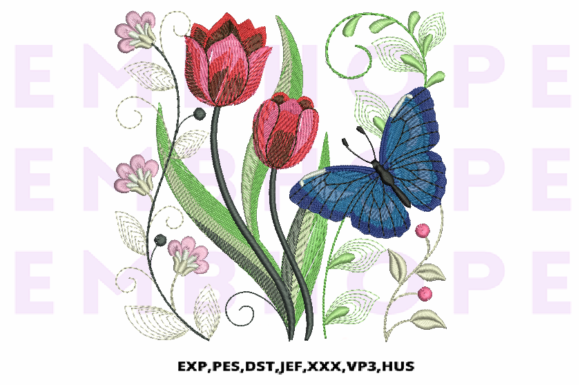
Flowers with Butterfly and Tulips
A Practical Review for Small Business Embroidery Projects
As an embroidery designer who’s developed hundreds of commercial designs for cafés, florists, boutiques, bakeries, and handmade brands, I approach every new machine embroidery design with two questions: “Will this strengthen my client’s brand identity?” and “Will it hold up in real-world production?” When I first saw Flowers with Butterfly and Tulips, my instinct was positive — but not because it’s pretty. It’s because its composition hints at versatility across small business merch: from embroidered patches on aprons to subtle sleeve details on staff uniforms.
First Impression: Friendly, Timeless, and Thoughtfully Balanced
The title alone — Flowers with Butterfly and Tulips — signals a gentle, nature-inspired aesthetic. It doesn’t scream “trendy” or “minimalist.” Instead, it leans into Floral Garden warmth: approachable, slightly romantic, and quietly confident. That’s ideal for businesses that want to feel human-centered — think a neighborhood florist’s tote bags, a pet brand’s bandana line, or a ceramic studio’s limited-edition aprons. It reads as handmade product without looking overly rustic, and elegant without feeling stiff. For small business owners choosing between bold logos and soft accents, Flowers with Butterfly and Tulips sits perfectly in the middle — professional enough for customer-facing staff wear, yet expressive enough for Etsy branding or boutique merchandise.
Where It Shines in Real Business Use
This embroidery file excels where subtlety meets storytelling. On a café’s linen apron? Yes — placed just above the pocket, it adds charm without competing with the logo. As a chest accent on a staff polo? Absolutely — especially when paired with a clean monogram or shop name nearby. For a local bakery’s reusable tote bag design, it works beautifully as a corner motif or centered low on the front panel. And as an embroidered patch, it holds strong visual weight even at 2.5"–3" wide — making it viable for cap embroidery (side or back), uniform sleeves, and product packaging accents like woven labels or fabric tags.
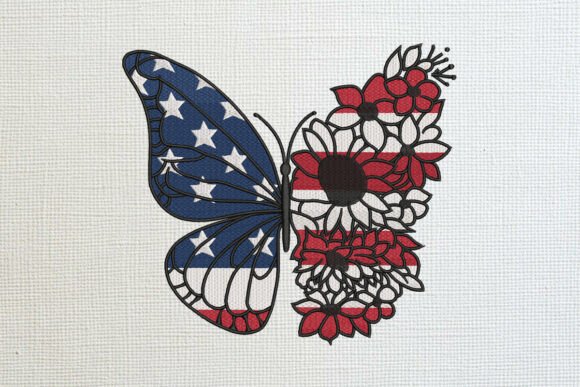
It also performs well in commercial embroidery workflows. The implied balance between floral elements and the butterfly suggests thoughtful spacing — critical when digitizing for varied hoop sizes. Because it’s rooted in the Embroidery category, not generic clip art, you can expect intentional stitch layering and natural flow between stems, petals, and wings. That translates directly to fewer thread breaks, smoother satin stitches on tulip curves, and better coverage over textured fabric like canvas or twill.
Use With Intention — Not Everywhere
That said, Flowers with Butterfly and Tulips isn’t a one-size-fits-all solution. Avoid placing it on high-curve surfaces like cap fronts unless you’ve tested the design’s stability at that scale — tight curves can distort delicate wing outlines or compress petal spacing. Similarly, skip using it below 2" wide without verifying how the butterfly’s antennae and tulip stamen read post-embroidery; fine details risk filling in or blurring on dense fabrics or with low-contrast thread colors.
Also consider fabric and care: if your client’s staff uniforms undergo frequent washing, confirm the stitch density won’t compromise durability — especially in areas where the butterfly’s wings meet the flower cluster. Dark uniforms demand careful thread color selection; test gradients or light pastels against navy or charcoal to ensure legibility. And never assume it’s optimized for sheer or stretchy materials — always pair it with the right stabilizer and run a sample on the actual garment.
How It Elevates Brand Identity and Customer Trust
Customers don’t just buy products — they buy feelings. A well-placed Flowers with Butterfly and Tulips design tells them your business values detail, care, and authenticity. On a handmade soap label or pet collar tag, it whispers craftsmanship. On a staff apron at a flower shop, it reinforces thematic consistency. Unlike generic stock icons, this design carries quiet narrative weight — butterflies suggest transformation and lightness; tulips evoke spring, renewal, and local charm. That emotional resonance builds recognition faster than a standalone wordmark alone.
For Etsy sellers and crafters, it deepens perceived value. Pair it with neutral-toned apparel and natural fibers, and you’re not selling a shirt — you’re offering a curated moment. That consistency across custom apparel, packaging, and digital assets (like a printable mockup) strengthens your visual language and makes repeat buyers feel like they’re part of something intentional.
Essential Designer Notes Before You Stitch
- Test in black and white first — assess contrast and clarity before committing to thread palettes.
- Check scalability — does Flowers with Butterfly and Tulips retain integrity at your smallest intended patch size?
- Review thread color contrast — especially for dark or textured fabrics.
- Inspect spacing — ensure no elements crowd each other when resized.
- Confirm hoop size compatibility — verify it fits within your standard frames or adjust accordingly.
- Test on real fabric — not just stabilizer swatches, but the exact material your client will use.
- Use proper stabilizer — cutaway for knits, tear-away for stable wovens, fusible for lightweight linens.
- Create a client mockup early — show how Flowers with Butterfly and Tulips integrates with their existing design assets.
- Compare beside other assets — does it complement, not compete with, your logo or typography?
- Confirm commercial licensing — this is non-negotiable for any digital embroidery file used in paid projects.
Remember: the description says it’s meant for pillows, towels, apparel, and home decor — and that’s accurate. But for small business use, its true strength lies in how thoughtfully it bridges decoration and identity. Whether you’re stitching apron embroidery for a creative studio or designing a tote bag design for a local florist, Flowers with Butterfly and Tulips offers more than beauty — it offers intentionality, adaptability, and quiet professionalism.