Patriotic Eagle American Flag
First Impression: Bold, Timeless, and Seasonally Charged
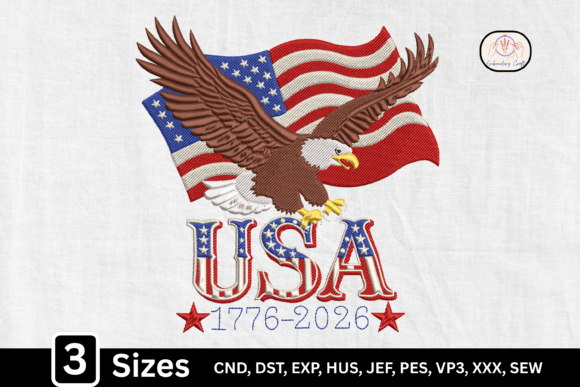
As an embroidery designer who’s curated seasonal collections for over 15 years, the Patriotic Eagle American Flag lands with immediate presence. It’s not just festive—it’s declarative. The bald eagle motif reads as strong and dignified, while the “USA 1776–2026” banner anchors it firmly in historical celebration—not generic patriotism, but a meaningful milestone. Visually, it strikes a balance between classic Americana and modern clarity: clean outlines, confident scale, and intentional negative space that lets fabric breathe. It feels premium—not kitschy, not cluttered—and carries emotional weight without leaning into nostalgia or solemnity. That duality makes it ideal for both spirited holiday apparel and refined home decor.
Real-World Seasonal Performance Across Product Types
This machine embroidery design shines where customers seek meaning *and* wearability. On sweatshirt embroidery, it holds up beautifully across chest, back, and sleeve placements—especially when paired with neutral bases like navy, charcoal, or heather gray. For tote bag design, its centered composition works seamlessly on canvas or denim, turning everyday carry into a quiet statement piece. Kitchen towel embroidery benefits from the eagle’s strong silhouette—stitching cleanly even on textured terry cloth when stabilized properly. As a pillow cover centerpiece, it adds gravitas to porch seating or living room accents without overwhelming the space.
It also excels in gift-ready contexts. Paired with matching baby onesies (smaller scaled version recommended), aprons, or embroidered patches, the Patriotic Eagle American Flag builds cohesive family sets—ideal for Etsy listings tagged “Independence Day matching outfits” or “250th anniversary gifts.” At craft fairs, I’ve seen this style stop foot traffic when stitched onto linen table runners or framed hoop art—its visual recognition is instant, reinforcing brand consistency across small shop product lines. Social media previews perform well too: the bold eagle translates powerfully in thumbnail size, and printable mockups let buyers imagine it on multiple items before purchase—boosting confidence and conversion.
Where to Use with Intention—Not Assumption
Even strong designs have boundaries. The Patriotic Eagle American Flag includes layered elements—feathers, flag folds, and fine lettering—that demand attention at smaller scales. Avoid placing it in hoops under 4x4 inches without verifying detail retention in the digital embroidery file. Tiny “1776–2026” text may blur on thick towels or dense terry unless stitch density is optimized—always test on your target fabric texture first.
Dark fabric requires careful thread color planning: white or metallic silver can pop, but avoid pale golds or pastels unless contrast is confirmed. Metallic thread adds shine but increases breakage risk—best reserved for low-wear items like ornaments or framed wall art, not high-wash items like baby onesies or kitchen towels. Stretchy garments (think performance tees or ribbed knit tanks) need cutaway stabilizer and reduced top tension to prevent puckering around the eagle’s wings. And curved surfaces—like baseball caps—require repositioning or digitized cap versions; don’t assume flat-hooped files adapt seamlessly.
Seasonal Appeal, Emotional Resonance, and Buyer Trust
This isn’t just another holiday embroidery file—it’s a storytelling tool. During peak Independence Day shopping, the Patriotic Eagle American Flag taps into collective pride and intergenerational connection. Customers don’t just buy a design; they buy continuity—1776 to 2026 is a narrative arc. That elevates perceived value, especially for handmade gift shoppers seeking something more intentional than mass-produced decor.
For Etsy sellers, it supports trust-building: clear, professional stitching signals craftsmanship, and the design’s balanced proportions reflect design discipline—not rushed digitizing. When used consistently across product categories (e.g., matching pillow covers + embroidered patches + tote bags), it strengthens visual recognition and encourages repeat visits. And because it avoids overused tropes (fireworks, stars-and-stripes overload), it stands out in crowded feeds and email campaigns—driving higher engagement during limited-time product drops.
Practical Embroidery Designer Notes for Seasonal Success
- Test thread colors on both light and dark fabric—especially for the eagle’s eye detail and flag stripes. What reads crisp on white may vanish on black without tone-matched thread.
- Check stitch density before scaling down. High-density fills won’t resolve cleanly below 3.5 inches wide—consider simplifying or using a variant file if available.
- Confirm hoop size compatibility across your production lineup. If you use multi-needle machines, verify nesting options for batch production.
- Use proper stabilizer—cutaway for knits and towels, tear-away for stable wovens. Skip fusible web alone; it’s not enough for eagle feather definition.
- Create realistic mockups—not just flat templates. Show how it looks draped on a tote, folded on a towel, or centered on a sweatshirt hem.
- Review small details after stitching: Are wing tips sharp? Is “1776–2026” legible at 2x viewing distance? If not, adjust underlay or reduce density in those zones.
- Plan matching color palettes—coordinate thread shades across product types so your seasonal collection feels unified, not pieced together.
- Confirm commercial licensing before selling finished seasonal products. This embroidery file is intended for commercial embroidery, but always verify terms—especially for resale on platforms requiring license documentation.
The Patriotic Eagle American Flag isn’t filler—it’s foundation. When thoughtfully applied, it transforms ordinary items into heirloom-caliber personalized gifts, supports cohesive seasonal embroidery launches, and meets real customer needs: meaning, quality, and visual impact—all without sacrificing wearability or production practicality. For small shop owners building holiday momentum, it’s less of a design choice—and more of a strategic advantage.