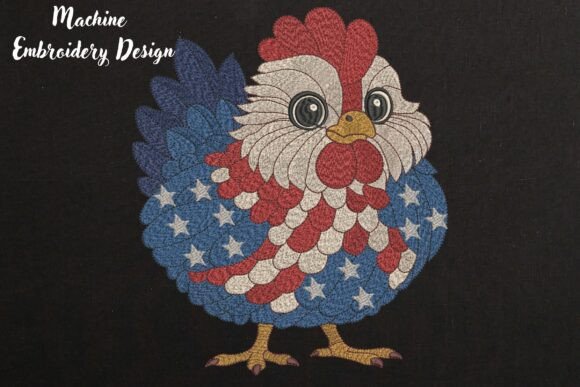
4th July American Chicken in Black
First Impression: Festive, Playful, and Instantly Recognizable
As an embroidery designer who’s prepped over 200 craft fair booths—and shipped thousands of embroidered small shop products—I’ll say this upfront: 4th July American Chicken in Black lands with cheerful, confident energy. It’s not subtle. It’s not minimalist. It’s festive, bold, and unapologetically patriotic—without tipping into cliché. The “chick covered in stars and stripes” concept reads immediately as fun, family-friendly, and handmade-charming. At a glance, it feels like a cross between vintage Americana and modern craft fair appeal: rustic enough for a farmhouse kitchen towel, lively enough for a kid’s cap, and clever enough to spark conversation at a boutique market stall.
Where It Shines: Top Craft Fair & Handmade Product Pairings
This design thrives where personality meets practicality. Here’s how it performs across key handmade categories:
- Tote bag design: Excellent focal point on the front panel—large enough to read from three feet away, charming enough to stop browsers mid-aisle. Works especially well on natural canvas or black cotton duck.
- Apron embroidery: A standout on the pocket or chest area. Adds whimsy without overwhelming the garment’s utility—ideal for bakers, gardeners, and small-batch food makers.
- Tea towel embroidery: Delivers strong visual impact against linen or waffle-weave textures. Just be mindful: fabric texture can soften fine details, so test stitch density on your exact towel stock.
- Embroidered patch: Highly versatile. Customers love collecting themed patches for jackets, bags, or denim vests—and this one reads clearly even at 3" wide.
- Caps and fabric pouches: Performs best when scaled thoughtfully. On curved cap surfaces, keep the design centered and avoid tight corners; on small pouches, use it as a single statement motif—not a repeating pattern.
- Pillow covers and market bags: Gives instant holiday warmth. Paired with red, white, and navy solids or gingham, it elevates a simple item into a giftable handmade product.
Real-World Selling Strengths
At a craft fair, attention is fleeting—and value is perceived in seconds. 4th July American Chicken in Black checks every box: it’s easy to understand at a glance, emotionally resonant (nostalgic + joyful), and highly photographable for Etsy listings or Instagram reels. Its contrast-heavy palette—especially against black fabric—makes it pop under booth lighting and translates cleanly to printable mockups. As a digital embroidery file, it’s repeatable across batch production without losing charm. No complex gradients or micro-details mean fewer thread breaks, faster hooping, and consistent results across dozens of tote bags or aprons.
Careful-Use Notes Every Embroidery Designer Should Know
Even delightful designs have limits—and skipping these checks can cost time, thread, and customer trust:
- Dense stitch areas: Stars and stripes often mean tight fills. Watch for overheating on thick fabrics or slow-speed machines. Always test on scrap before running 50+ units.
- Tiny details: If the chick’s beak, eye, or star outlines are under 1.5mm, they may blur on textured towels or dark fabric. Zoom in on your embroidery file preview before cutting.
- Dark fabric contrast: “Black” in the title suggests it’s optimized for dark backgrounds—but confirm thread colors support visibility. White or metallic silver top threads often lift the design beautifully.
- Curved surfaces: Caps and pouches require careful hooping and stabilizer selection. Use cutaway + tear-away combo for clean edges and minimal puckering.
- Small-scale legibility: Below 2.5", the flag patterning may collapse visually. Reserve smaller sizes for patches or labels—not intricate appliqué accents.
How It Elevates Your Booth, Brand, and Buyer Engagement
A well-chosen machine embroidery design does more than decorate—it builds cohesion. 4th July American Chicken in Black strengthens your booth display by anchoring a patriotic theme across multiple product types (tote, apron, tea towel, patch) while keeping each item distinct. That consistency signals professionalism to buyers—and makes your table feel intentional, not cluttered. For Etsy sellers and small shop owners, it adds perceived value: customers pay more for finished product that looks custom-designed, not clip-art-generic. And because it’s rooted in a shared cultural moment (Independence Day), it sparks immediate connection—“Oh! I need that for my BBQ!”—which shortens decision time and lifts average order value.
Pro Designer Checklist Before You Stitch
Before turning 4th July American Chicken in Black into your next wave of craft fair inventory, run through these non-negotiable steps:
- Test the embroidery file on your exact fabric—same dye lot, same finish.
- Check thread contrast against both light and dark backgrounds.
- Review spacing between elements: does the chick’s wing clear the border? Does the stripe rhythm hold at your target size?
- Confirm hoop size compatibility—especially if you’re using multi-hoop setups for large tote panels.
- Inspect stitch density: high-density fills need stronger stabilizer (e.g., medium-weight cutaway for cotton blends).
- Create at least one real mockup—not just a digital render—to assess drape, texture interaction, and true-to-life scale.
- Compare fabric colors side-by-side: navy vs. black vs. charcoal behave very differently under thread.
- Verify commercial licensing status—this is essential for selling finished product, not just the digital embroidery file.
When executed with intention, 4th July American Chicken in Black isn’t just another Independence Day embroidery—it’s a reliable, joyful, and commercially smart design asset. It fits seamlessly into your creative workflow, connects authentically with customers, and delivers real returns at the craft fair, on Etsy, and beyond.