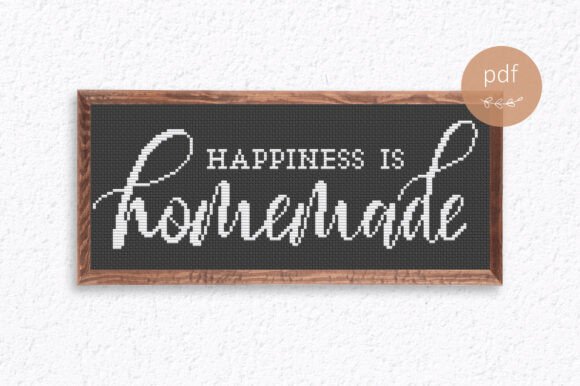
Home Cross Stitch Pattern PDF Quote
A Practical Review for Small Business Merchandise & Branded Patches
As an embroidery designer who’s developed hundreds of commercial designs for cafés, boutiques, bakeries, florists, and handmade brands, I approach every pattern with two questions: “Will this hold up in production?” and “Does it strengthen the brand—not just decorate it?” That’s why I took Home Cross Stitch Pattern PDF Quote straight to the hoop—not as a hobbyist, but as a production partner for small businesses.
First Impression: Warm, Handmade, and Intentionally Minimal
The title alone—“Welcome Home Cross Pattern”—immediately signals warmth, hospitality, and grounded authenticity. Combined with the stated design area (9.64 × 3.21 inches), Aida 14 count fabric guidance, and just one DMC thread color, this isn’t a fussy, ornate motif. It’s intentionally lean: 135 × 41 stitches means low stitch density, clean line work, and strong legibility—even at reduced scale. Visually, it reads as handmade but professional, rustic but refined, and classic without feeling dated. That balance is gold for small business branding—especially when you’re stitching on aprons for a neighborhood coffee roaster or patches for a pet wellness studio.
Real-World Performance Across Merch Channels
Embroidered patches: At its native size (nearly 10″ wide), this pattern shines as a full-back patch on denim jackets or tote bags—but more importantly, it scales down cleanly. Because it avoids fine interior detail and relies on bold, open letterforms and a clear central motif, it holds integrity even at 2.5″–3″ width. That makes it viable for chest logos on staff uniforms, sleeve accents on chef coats, or cap fronts where clarity trumps complexity.
Custom apparel & accessories: For apron embroidery, the horizontal proportion fits perfectly along the top pocket band or center chest panel. On caps, I recommend using the core “HOME” portion only (cropping the “Welcome” and “Cross” elements) to avoid stretching across curved surfaces—this preserves readability and reduces digitizing risk. As a tote bag design, it anchors beautifully near the handle seam or centered below the brand logo.
Product packaging & branded assets: When printed as a label or woven into fabric tags, the simplicity of Home Cross Stitch Pattern PDF Quote translates well to screen printing and heat transfer—making it a flexible asset across both stitched and non-stitched touchpoints. Its single-color nature also simplifies inventory: one thread spool covers all production runs.
Where to Use With Care—And Why
This design excels where many cross-stitch patterns falter in commercial use—but it still has boundaries. Avoid placing it on tiny curved surfaces like baseball cap visors or narrow wristbands without testing first. The 9.64″ width also means it won’t fit inside standard 4″ hoops without repositioning—so confirm your machine’s maximum hoop size before digitizing.
Also, while the single DMC color simplifies execution, it demands attention to thread contrast. On dark uniforms or textured fabrics like canvas or twill, test stitch on actual material with proper stabilizer—especially medium-weight cutaway for structured items like caps or tote straps. And though the lettering is generous, don’t shrink it below 1.75″ width without verifying spacing between characters; tight kerning can blur under dense stitching or after repeated washing.
Brand Identity Impact: More Than Just a Motif
Small businesses don’t just sell products—they sell belonging. Phrases like “Welcome Home” resonate deeply with local, values-driven audiences. When stitched onto staff aprons or customer totes, Home Cross Stitch Pattern PDF Quote quietly communicates care, consistency, and craft—not corporate polish. That builds trust. Customers notice when a bakery’s barista wears an apron with hand-stitched warmth instead of a generic logo. They remember the florist whose delivery tote carries that same gentle phrase in thread.
It also supports visual consistency across channels: the same design can appear as a physical patch, a printable mockup for social media, a digital watermark on Etsy listings, or even a simplified vector version for labels—all anchored by the same recognizable rhythm and spacing. That cohesion elevates perceived value and reinforces handmade positioning without sacrificing professionalism.
Designer Notes You Can’t Skip Before Production
- Always test in black and white first. Monochrome reveals spacing issues, unintended gaps, and density imbalances that color can mask.
- Verify small-patch viability. Resize to your target patch dimensions (e.g., 2.25″ wide) and check if “HOME” remains crisp and evenly spaced.
- Review thread color contrast on your base fabric. One DMC color doesn’t mean one universal solution—test on light, dark, and mid-tone substrates.
- Inspect character spacing and stroke weight. Especially where “WELCOME” meets “HOME”—tight junctions may need slight adjustment for clean stitch-out.
- Confirm hoop compatibility. At 9.64 × 3.21 inches, this exceeds many standard 5″ or 6″ hoops—plan for multi-hooping or larger frames.
- Use appropriate stabilizer. Medium-cutaway for structured items; tear-away for lightweight cottons or linens.
- Create a physical mockup before client approval. A photo of the stitched sample on real fabric beats any digital proof.
- Compare alongside existing design assets. Does it complement your logo, typography, and other embroidered elements—or compete with them?
- Confirm commercial licensing. Since this is listed as a Cross Stitch Patterns product in the Graphics category, verify whether the PDF includes permission for resale, merch use, or mass production—don’t assume.
In short: Home Cross Stitch Pattern PDF Quote isn’t just another decorative download. It’s a thoughtfully scaled, production-ready foundation for small business identity—whether you’re stitching patches for a handmade soap brand or building cohesive merch for a creative studio. Its strength lies in restraint, rhythm, and resonance. Used intentionally, it doesn’t just say “Welcome Home.” It helps your customers feel like they already are.